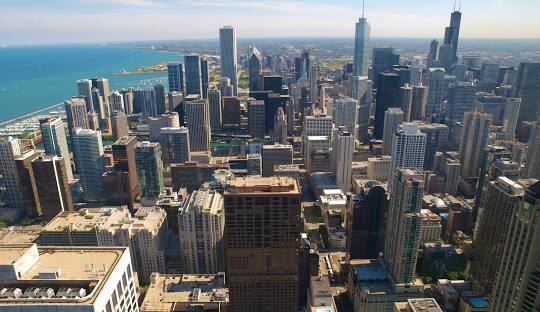
Chicago: From Fire to Global Powerhouse
Posted by on
Chicago, Illinois, incorporated as a city in 1837 near a vital portage connecting the Great Lakes and the Mississippi River watershed, quickly became a major center of trade and growth in the 19th century. Despite the devastation of the Great Chicago Fire in 1871, which destroyed several square miles and left over 100,000 people homeless, the city rebounded and continued its rapid expansion. Chicago became a leader in urban planning and architecture, pioneering the Chicago School, the City Beautiful movement, and the development of steel-framed skyscrapers that define its iconic skyline.
Today, Chicago stands as an international hub for finance, commerce, industry, education, culture, and transportation. Its financial markets, particularly derivatives, are among the largest and most diverse in the world, while O’Hare International Airport consistently ranks as one of the world’s busiest airports. Chicago’s railroad networks further cement its role as a critical transportation hub. The city’s metropolitan GDP exceeded $919 billion in 2024, making it one of the most economically powerful urban regions globally, with a workforce spread across diverse industries.
Chicago is also a major destination for tourism, drawing over 55 million visitors in 2024 to its museums, theaters, restaurants, beaches, and cultural landmarks. The city is renowned for its contributions to music, including jazz, blues, gospel, hip-hop, and house music, as well as its thriving theater, dance, literature, and visual arts scenes. Landmarks like the Art Institute of Chicago, the Lyric Opera, and cultural institutions provide world-class arts experiences, while universities such as the University of Chicago, Northwestern University, and UIC make the city a center for education and research. Sports enthusiasts enjoy the city’s professional teams across all major leagues, including two Major League Baseball franchises, while annual events like the Chicago Marathon highlight the city’s global appeal.